Sunday, July 14, 2019

Birdsville Town Common

It's almost a year to the day since we last visited Birdsville.


This will be our second year attending the Big Red Bash. As we did last year, we arrived nine days before our two-day early entry pass begins. Aside from our unplanned trip to Bedourie, our days have been spent reading, relaxing, taking walks, and checking out the new arrivals who appear each day. At first, it's just a trickle, but as the week goes on, the numbers increase.


Thankfully, due to recent rains, most of the camping area is now covered in grass, so hopefully, there will be less dust swirling around this year.


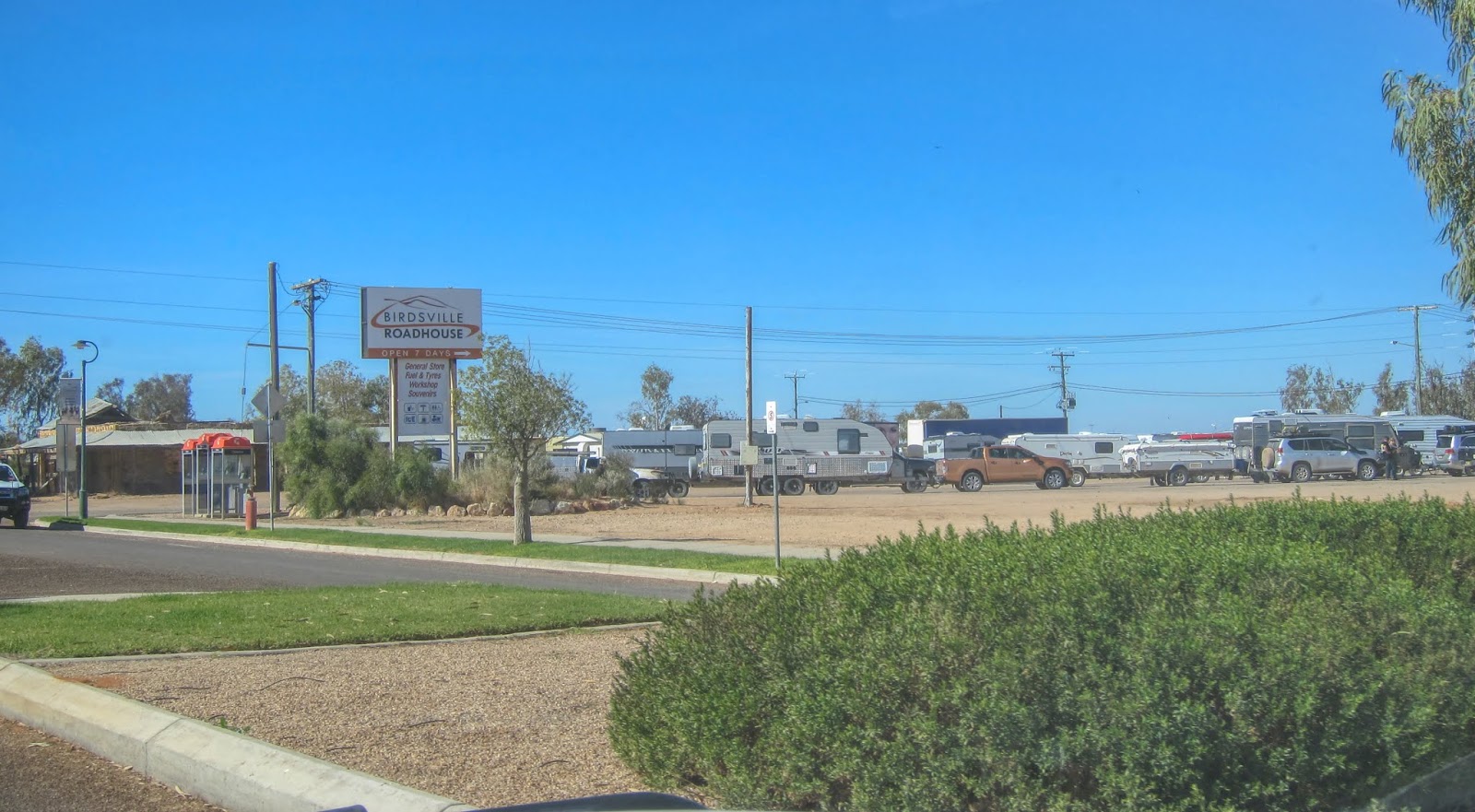
About a month ago, the entire town common was submerged underwater, reaching up to the spot where this photo was taken, just before the final grid into town.


Arriving early and leaving Birdsville three days after the event has finished ensures that we avoid the mad rush. There is no need to contend with people who are unaware or simply do not care about outback travel etiquette.


What do I mean by that? When passing a slower vehicle, it is generally accepted that you slow down and move to the other side of the road rather than passing at speed and showering the overtaken vehicle with stones. We have seen this far too often during our travels.


Whenever we visit Birdsville, we always camp on the town common, just south of the town. It is a vast area that can accommodate thousands of campsites. If you are totally self-contained like us and do not mind using your own onboard facilities, then it’s a great option with the added bonus of about a dozen water points spread throughout the area. Camping here is free, and it's an easy walk into Birdsville for a beer.


Birdsville's water is sourced from the Great Artesian Basin by a bore sunk to a depth of 1.2 kilometres, which pours out at 98 degrees Celsius and is cooled before it can be used.


Another advantage of arriving early is securing a good spot to camp. We always seek a site free from constant through traffic, so we're not covered in dust from passing vehicles.
 
As we age, we like to think we’re also becoming wiser. With this in mind, this year, we purchased a 110-litre water bladder that sits on the floor behind our two front seats.
 
The days of lifting a 20-litre bucket are behind us. Now, it’s simply a matter of connecting our portable 12-volt pump to the bladder to transfer water, powered by our Anderson plug on the van’s drawbar.
 
Tuesday evening marks the final buffet dinner at the Birdsville Hotel before the 'Bash', and we’ll be dining with fellow Bushtracker owners Glenda and Steve. From tomorrow evening, there will be two sittings with a set menu.


We both chose the lamb shanks, which were delicious, and the vegetables were still lovely and crunchy.


One of our daily walks took us past Pelican Point and to the billabong located on the outskirts of town, behind the caravan park.


In April 2017, the Birdsville Bakery was purchased by new owners, and we enjoyed some of their products at the bash last year. Unfortunately, due to financial reasons, the bakery closed its doors in early June.


After our walk today and using my phone app, I found that our site is 1.5 km from the hotel. The caravan park, along with the common area, is starting to fill up quite quickly.


As we walked back to our site this afternoon, a food truck had just arrived.


Our dinner last night consisted of sweet Bangalow pork cutlets that we purchased from Bellingen before leaving home, with sweet potato and apple slices.


Sunsets have been few and far between, but last night's made up for the lack of them.


This morning, we picked up our wristbands and our two-day early entry pass for the windscreen of the car.


A last run to the rubbish dump this afternoon before heading out to the 'Bash' site tomorrow with still more vans and trailers arriving this afternoon.

Saturday, July 6, 2019

An unscheduled trip to Bedourie

Before arriving in Farina, we thought we could smell gas coming from the cupboard under our sink in the ensuite. Mind you, at that time, it was only a very faint smell.
 
We were still on the blacktop and had not yet hit the dirt, so we could still cook and enjoy hot showers. 
 
We aired down in Marree, as we usually do when towing the van over dirt roads. The 4WD tyres were reduced to 32 psi and the van's tyres to 25 psi, to ensure a comfortable cushion for both vehicles.
 
Our trip along the Birdsville Track wasn't particularly harsh, though the floodways and dry creek beds were quite rough and stony.
 
Upon arriving at Mungerannie, we turned on the gas to heat our shower water, but the overpowering smell of gas prompted us to turn the valve off immediately.
 
A spray bottle with soapy water indicated gas escaping from a hairline crack on the bottom nut of the tap that isolates gas to the hot water system.


We'd already planned to eat at the roadhouse that evening. As we were heading to the 'Bash', we purchased large wet wipes to use on off days, so all our requirements were met.


By the time we arrived in Birdsville, the crack in the nut had grown larger, with part of it broken away.


Oh dear, here we were in Birdsville, planning to stay for seventeen days. We would be without any cooking or hot water for the entire period. The thought of having to drive to Mt Isa for repairs, a round trip of over 1300 km, filled us with dread.


There was no one here in Birdsville who could help, so I rang the information centre in Boulia without success. As a last resort, I called the shire office in Bedourie. Luckily, they had a gas plumber working for them, and he would contact us.


Fortunately, as soon as he rang me back, we headed the 187 km to Bedourie, arriving just at lunchtime. We parked opposite the pub, and Wayne, our saviour, called about ten minutes later. He checked the damage and said he'd be back at three after finishing work.


While we waited, we wandered across the road to the pub for one of their $10 lunch specials and a cold beer. Neither the exterior nor the interior has been improved in a very long time.  


The saga continued from there with Wayne unable to find the right-sized nut in the council workshop. In the end, he used a drill press on a smaller nut to make it fit. All of this took just over two hours to complete.
 
When I asked him how much he wanted for his time, he said $50 would do. However, we were just so grateful that we didn't have to drive to the Isa, so we gave him $250 instead.
 
We headed south for 68 km to spend the evening camping at Cuttaburra Crossing. We have passed by here on more than one occasion, so this would be ideal for us. That evening, we enjoyed a lovely hot shower, a hot meal, and a cup of coffee, thanks to Wayne.


An early start the next morning, with just 120 km to go until we reached Birdsville.

Friday, July 5, 2019

The Birdsville Track

Today marks our second trip along the Birdsville Track. 


We took a relaxed start this morning, with about 240 km to travel today. 

Another surprise awaited us, as the remaining section of the road to Marree has now been upgraded to bitumen. You can now drive the 77 km from Lyndhurst to Marree in any weather conditions. We crossed it many years ago after a light shower, and it was quite an experience trying to keep ourselves and our van on the wet surface.


We have camped in Marree before and passed through numerous times, so today's visit is just a quick stop for a photo. Afterwards, we will spend some time reducing the tyre pressures on our 4WD and van for the upcoming 517 km journey towards Birdsville. 


The track passes through one of the driest parts of Australia and cuts across parts of the Strzelecki, Sturt Stony and the Tirari Deserts. Much of the road surface is made up of gibber stones, and although the trip is not terribly demanding, it still requires care to be taken.


A 4WD and quality all-terrain tyres with lower pressures and reduced speed can help minimise the risk of tyre punctures and potential breakdowns. 
 
We have travelled extensively across Australia and along nearly every dirt road available. Always reducing our tyre pressures, we have not experienced any tyre damage in over thirty years.
 
On our previous journey, we camped at  Mungerannie before reaching Birdsville.  Last time, we towed a camper trailer, but thankfully, now we have more creature comforts to look forward to at the end of the day.
 
We stopped to explore the Lake Harry Ruins, 31 km from Marree, where in the early years there was hope to grow date palms. The water from a bore was enough for the palms to thrive, but issues with pollination eventually ended this project.


We came across the 'Dog Fence' just 12 km later. We have seen parts of it on many of our travels around Australia. It's a 5600 km fence that was built in the 1800s to keep dingoes to the north and help protect the flocks of sheep in the south.


We passed by Clayton's Wetland Campground. It's $10 per vehicle fee includes access to facilities such as showers, toilets, and even a spa powered by a nearby bore. Of course, it was far too early in the day for a stop, and besides, why pay to camp when we have our own facilities—minus the spa, of course—so we continued on.
 
A further 90 km along the track brought us to the Cooper Creek crossing. Luckily for us, the rain in late April, which had caused the track to be closed due to significant flooding, has now dissipated. We are now confronted with a dry plain; otherwise, we could be stranded here indefinitely.


Just 15 km later, we arrived at the Mulka Ruins, where we paused briefly to take some photos and 

explore the remaining site. Most of the structure has crumbled to the ground, with only part of the fireplace still standing.


A store was established here in the early 1900s to serve the drovers transporting stock to Marree.


Originally, we planned to camp overnight near the ruins, but it was still relatively early in the day and there was a strong eastward gale, so we decided to head to Mungerannie instead, where we knew we could find shelter among the bushes and be protected from the constant wind. 


Mungerannie Roadhouse is nearly halfway along the track and is the only permanent establishment. Facilities include cabin accommodation, a campground with amenities, tyres, basic repairs, fuel, as well as meals and a cold beer. The current diesel fuel price is $1.95 a litre, but with our long-range tank, we can reach Birdsville without needing to top up. Campground charges are $10 per person with all facilities available, but we weren't interested in staying there. We simply visited the pub for a few beers and dinner before retiring.


The rest of our trip to Birdsville was quite uneventful, although there was a bypass installed to go around part of the track that is still under water. Water was also covering the track in other areas.


It's incredible how a little bit of rain brings the desert back to life.


We did pass the Birdsville inside track 140 km after leaving Mungerannie. Although it's a shorter distance of about 40 km, it's typically closed as part of the track crosses Warburton Creek. 

Just 58 km later, we passed by the Walkers Crossing track, which comes in from Innamincka.

Arriving in Birdsville, we set up on the town common south of town.

Wednesday, July 3, 2019

Farina - Ghost Town

Only 169 km to drive today after our night at Edeowie Station. As soon as we reached the bitumen, we headed north towards Parachilna and the Prairie Hotel, made famous by its 'Feral Mixed Grill' menu, which includes kangaroo, emu, and camel. It was far too early in the day for a beer, so instead, we just took some photos before continuing on.


Not long after, we stopped beside the road to photograph one of the railway sidings built alongside the old Ghan railway line. Many of these can be seen further north along the Oodnadatta Track.


Continuing further north, we passed Leigh Creek. The town was established to support a nearby large coal mine. Sadly, the mine has now closed, and the population has decreased from 2500 to just 200 today. It's disheartening to see how this once-thriving town, which we fondly remember from our first visit in 1994, has changed.
 
There is talk of a company wanting to extract gas from the old mine site, so hopefully, this will help rejuvenate this once-busy town.
 
Oh dear, unfortunately, it was morning tea time when we stopped 6 km later at the famous Copley Bush Bakery, where we shared a quondong pie with our coffees.


It wasn't long before we arrived at Lyndhurst, where the Strzelecki Track begins its journey towards Innamincka. Here, we refuelled before making a brief stop at the Ochre Pits just north of the town. 


This site was an important gathering and trading location for Aboriginal people, with ochre colours utilised in ceremonies, art, and medicine.


There is simply no stopping progress, as it was quite a shock to realise that the dirt road just north of Lyndhurst is now bitumen all the way through to the Farina turnoff.

This may be our sixth visit to Farina, in the far north of South Australia.

You might wonder why we have been here so many times. Well, there are many reasons for our visits.


Marree is just north of Farina and serves as the starting point for those seeking to drive along either the Oodnadatta or Birdsville Tracks. Over the past 25 years, we have driven the Oodnadatta Track on numerous occasions, in both directions, and once previously along the Birdsville Track.


Another reason for our continued visits is to observe the progress of the restoration of this once-thriving town. In 2008, a restoration group was formed, and over the past eleven years, the number of volunteers has steadily increased from 30 to over 150. 


These dedicated volunteers make themselves available during the winter months to restore these beautiful stone buildings so they no longer deteriorate further.


Steve, the project manager, explained that it's not a complete restoration due to the amount of red tape, hurdles, and bureaucratic requirements they would need to navigate for a full rebuild. 

When we first visited in 1994, only one building was still intact—the bakery. Its survival against the harsh conditions surrounding this once-bustling town, where everything else had crumbled and fallen, was because it was an underground bakery.


In 1878, Farina was first settled, and by the late 1890s, more than 600 people were living there. During the early years, the rains were constant, but after many years of poor rainfall, the hopes of growing wheat crops began to fade.

Fortunately, the alignment of the Ghan railway kept the town alive, but when the line was relocated further west in 1980, that was the final blow.
Apart from the history linked to this once-thriving town, we truly love the surrounding countryside, with its gibber plains and red dirt, which has continually drawn us to the outback for the past 25 years.

In recent years, the bakery has operated from late May until the end of July, producing freshly baked bread, pies, pasties, and buns from its wood-fired oven.


And each year, a substantial amount of money is raised through the bakery, with all the proceeds going back into the restoration of the town.


All our previous visits have been much later in the year, so we have yet to experience the joy of buying freshly baked goods in almost the middle of nowhere.

Thanks, Ros, a finger bun for me, and a matchstick for her. When we lived in Canberra and travelled to the coast, we would always stop in Nimmitabel, and Ros would always buy a matchstick. She said the ones here at Farina are as good as the ones she used to buy all those years ago.


Camping is available, complete with showers and toilets, but please note that there is no drinking water. Fees are $5.00 per person per night, and firewood is available to purchase.


Talk about 'boot hill' as portrayed in the many Western movies from years ago. 


I could only imagine how difficult it would be to dig graves when the surface at the cemetery is made up of gibber stones.


A must-visit is the town's cemetery, perched on a rise a few kilometres from the former township. Records indicate that several hundred people are buried here, including many Afghans who ferried goods further north, using camels before the railway was extended beyond Farina.